
Quick Summary
This guide outlines how to identify and resolve common Craftsman garage door opener failures, including worn drive gears, degraded start capacitors, and misaligned safety sensors. While post-1993 models are typically cost-effective to fix with individual replacement parts, Reliable Garage Door Service Port Charlotte provides specialized diagnostics to determine whether targeted repairs or modern system upgrades offer the best value. Readers will learn how to interpret diagnostic blink codes, evaluate balance and safety criteria, and know when to schedule same-day professional service.
Craftsman Garage Door Opener Repair
When a Craftsman garage door opener stops working, the issue often involves wear items such as drive gears, lubrication breakdown, a start capacitor, or safety sensor alignment. Many Craftsman openers were manufactured on the Chamberlain platform, allowing for shared component compatibility and widely available replacement parts. Over time, frequent cycling and garage heat can lead to component wear, preventing the door from operating normally.[2]
Whether dealing with a chain-drive model or a belt-drive system, consulting manufacturer documentation can help determine whether a specific part replacement or a system replacement is appropriate.
Overview of Craftsman Garage Door Opener Repair
Craftsman garage door opener repair in brief: Common Craftsman opener issues often involve nylon drive gears, start capacitors, optical safety sensors, or logic boards. Depending on local labor rates and parts required, professional repairs typically range between an estimated $120 and $250 according to general industry averages, compared to the cost of a full unit replacement.
Before replacing an entire unit, inspecting the system with guidance from specialists like Reliable Garage Door Service Port Charlotte helps identify whether the issue is mechanical or electrical. In many cases, replacing a specific worn part can restore operation without requiring a full opener replacement.
Common Opener Symptoms
According to standard manufacturer troubleshooting guides, Craftsman openers may exhibit symptoms such as:
- Motor hums for a few seconds but the chain or belt does not move: Can indicate a worn drive gear assembly or a faulty motor start capacitor.
- Opener runs briefly and reverses: Often caused by misaligned safety sensors, RPM sensor issues, or excessive mechanical friction along the door tracks.
- Wall console lights blink: Typically indicates an active diagnostic code or an engaged vacation lock switch.
- Remote controls do not respond while the wall button works: Often points to depleted remote batteries, radio frequency interference, or an issue with the receiver logic board.
Opener Wear in High-Temperature Environments
In hot climates, unconditioned garages can experience sustained high temperatures, which may accelerate the degradation of certain electro-mechanical components:
Capacitor Wear
When an opener hums without turning the drive mechanism, the AC start capacitor may have failed. Prolonged exposure to elevated ambient temperatures can degrade internal electrolytic components over time, leading to swelling, leakage, or loss of capacitance. Replacing a damaged capacitor according to manufacturer specifications restores proper motor startup.
Grease Breakdown and Gear Wear
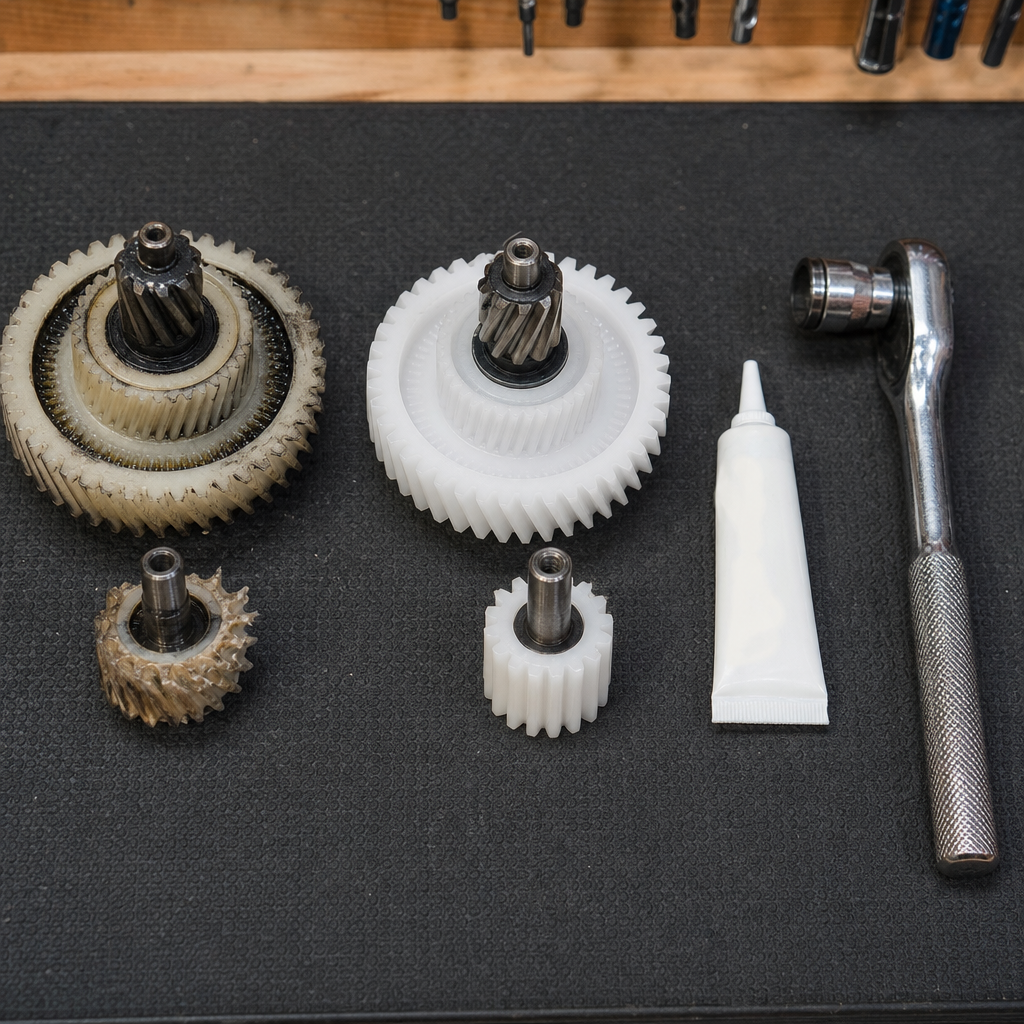
Many Craftsman chain and belt drive models utilize a nylon helical gear paired with a steel worm gear. Over extended periods in high heat, factory lubrication can migrate away from contact surfaces. Insufficient lubrication can accelerate friction and wear on the nylon gear teeth, eventually requiring replacement of the gear and sprocket assembly.
Troubleshooting Opener Components: Sensors, Gears, and Controls
Need craftsman garage door opener repair?
We’re available now — call for a fast, free estimate.
Troubleshooting should follow the specific model’s operator manual, beginning with checking indicator lights on the motor housing or wall console.
Diagnostic Blink Codes
Many Chamberlain-manufactured Craftsman openers feature an LED diagnostic indicator near the “Learn” button. While diagnostic code definitions can vary by model and generation (consult your specific owner manual for exact mappings), common diagnostic patterns include:
| Blink Code | Indicated Condition | General Service Step |
|---|---|---|
| 1 Flash | Sensor wire disconnected or shorted | Inspect bell wire connections between the sensors and the motor unit. |
| 2 Flashes | Safety sensor misaligned or obstructed | Clean sensor lenses and adjust brackets until indicator LEDs illuminate steadily. |
| 4 Flashes | Travel limits out of adjustment or RPM error | Check limit adjustments and inspect the internal RPM sensor assembly per manual instructions. |
| 5 Flashes | Motor thermal overload or RPM sensor interruption | Allow the motor to cool; check the RPM sensor board if the symptom persists. |
Safety Sensor Alignment
Standard safety reversing sensors mount on both sides of the garage door opening, typically four to six inches above the floor. One sensor sends an infrared beam to the receiving sensor. If dirt, physical misalignment, direct sunlight, or loose brackets disrupt this beam, the opener will not close via remote control, and the main overhead light typically flashes ten times as an indicator. Realigning and securing the brackets resolves most optical alignment issues.
Testing Garage Door Balance
Manufacturer guidelines recommend testing door balance before adjusting opener settings or replacing parts. Disengage the opener using the manual release handle while the door is fully closed, then manually raise the door to approximately waist height. A properly balanced door should remain in place with minimal movement. If the door falls or feels unusually heavy, the counterbalance spring system requires service. Garage door springs operate under high tension and should only be adjusted by trained service professionals, such as the team at Reliable Garage Door Service Port Charlotte.
Repair vs. Replace Considerations
Deciding whether to repair a Craftsman opener or install a new system depends on unit age, parts availability, and modern safety guidelines.
| Feature | Pre-1993 Openers | Modern Replacement Openers |
|---|---|---|
| Safety Eye Sensors | Not standard (mechanical reverse only) | Standard infrared photo-eye sensors |
| Drive Motor Style | Standard AC motor | AC or DC motor options |
| Battery Backup | Not available | Available on select models |
| Connectivity | Requires external adapters | Integrated wireless features available |
Safety Standards and Age Considerations
Under the UL 325 safety standard revised in early 1993, residential garage door openers manufactured for the U.S. market are required to include secondary external entrapment protection, such as photoelectric sensors. Industry guidelines and safety organizations recommend replacing pre-1993 openers that lack external entrapment protection rather than attempting repairs.[1]
When to Repair vs. Replace
For units manufactured after 1993 that feature external safety sensors, replacing standard wear components such as gear assemblies (typically $40-$60 for parts) or capacitors (typically $15-$30 for parts) can be a practical option. If the logic board has sustained significant electrical damage, the motor has failed, or the opener is nearing the end of its useful service life, installing a new opener may provide greater long-term reliability and modern safety features.
Frequently Asked Questions
How much does it cost to repair a Craftsman garage door opener?
Professional repair for a Craftsman opener generally ranges between $120 and $250 on average, depending on local labor rates and the specific parts needed (such as replacement gears, capacitors, or circuit boards).
Why is my Craftsman garage door opener not working or responding?
Common causes include a lack of power at the outlet, an engaged “Lock” mode on the wall console, depleted remote batteries, or an internal component failure. If the motor hums but does not turn, the drive gear or start capacitor may require service.
Can an older Craftsman garage door opener be repaired or should it be replaced?
Units manufactured after 1993 that incorporate photo-eye safety sensors can generally be repaired using compatible replacement parts. Openers produced prior to 1993 lack modern secondary entrapment protection standards and are recommended for replacement.
Why is the light blinking on my Craftsman garage door opener?
If the main overhead light flashes ten times when attempting to close the door, it generally indicates that the safety reversing sensors are obstructed or misaligned. If an LED on the motor head or wall console is flashing, it indicates a specific diagnostic code or an active lock feature.[3]
Who repairs Craftsman garage door openers?
Professional garage door service technicians, including providers like Reliable Garage Door Service Port Charlotte, routinely repair Craftsman openers. Because many Craftsman models share mechanical platforms with Chamberlain and LiftMaster units, compatible replacement parts are commonly stocked for standard service calls.
How do I troubleshoot common Craftsman garage door opener error codes?
Refer to the diagnostic LED on the motor unit and count the flashes. Consult the specific model’s owner manual or service documentation to match the flash count with the corresponding diagnostic step, such as sensor alignment, wiring checks, or limit adjustments.
Need craftsman garage door opener repair?
We’re available now — call for a fast, free estimate.
Sources
- CPSC, Chamberlain Group Announce Recall to Repair … – cpsc.gov
- [PDF] 1997 Annual Report of CPSC actions and activities – cpsc.gov
- Garage door won't move: motor and travel troubleshooting video – searspartsdirect.com
Frequently Asked Questions
Are Chamberlain and LiftMaster replacement parts compatible with Craftsman garage door openers?
Yes, because most Craftsman models were manufactured on the Chamberlain platform, key components like drive gear kits, safety sensors, and logic boards are cross-compatible. Reliable Garage Door Service Port Charlotte stocks these interchangeable parts to provide prompt, same-day repairs without waiting for discontinued Sears inventory.
Can I add smart Wi-Fi controls or battery backup to my existing Craftsman garage door opener?
Post-1993 Craftsman openers can often be retrofitted with external wireless hub adapters for smartphone access, but integrated battery backup typically requires a complete unit upgrade. Reliable Garage Door Service Port Charlotte can evaluate your current opener to determine whether an add-on adapter or a modern, feature-packed replacement offers the best long-term value.
What is the typical lifespan of a Craftsman garage door opener, and when is replacement better than repair?
Craftsman openers typically last between 10 and 15 years, though high temperatures and heavy daily use can accelerate gear and capacitor wear. If your unit is over 15 years old, lacks photo-eye sensors, or faces major circuit board failure, Reliable Garage Door Service Port Charlotte can help you upgrade to a safer, quieter system rather than investing in recurring repairs.
About the author
 |
Brian Thompson Brian is a certified garage door technician with over eight years of experience serving the Port Charlotte area. He specializes in residential garage door repair and the installation of modern opener systems. Before focusing on garage door mechanics, he earned an Associate Degree in Construction Technology from Florida SouthWestern State College, giving him a strong foundation in building safety and structural integrity. |
Garage door broken, stuck, or off track?
We’re available now — call for a fast, free estimate.
Get Started